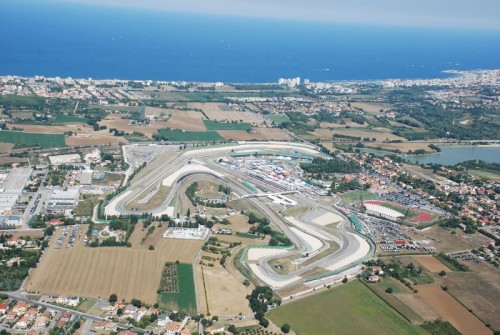
Misano Adriatico for beach lovers and F1 aficionados

circuito_2

Misano Adriatico has  its roots in the fertile Roman period. The name derived from that of various gens who moved  to live in the countryside of Rimini. In the 3rd century. B.C. in the territory of Misano came in fact “Gens Mesia”, thanks to “Ariminensis ager”,  the number of lands and possessions of Rimini that the Empire lavished to war veterans or to the nobles of Roman society for special merits.
The history of Misano is connected  with Rimini, like many locations in  Romagna. From 1295 to 1528, Misano lived moments of glory and power under the guidance of the future  capital of the province in a prolific period of history and art. Thanks to Malatesta, who did even build a castle here (today there are unfortunately only ruins), Misano became a splendid town. The Romagna then with the decadence of the “signori” become prey of the Pope’s  greed. As soon as the  hegemony of Malatesta flakes and until the unification of Italy, Misano belonged steadily to the Stato Pontificio.

In 1938 the town was known, however, with another name:,”Villa Vittoria”: it had this name since 1862, but then during the fascism that agricultural area became “Misano Adriatico”. The name change does it profit, and in the boom years Misano becomes highly tourist, tracking and seeds thrown in this direction already in the thirties. Today we have many well-known structures, such as hotels and hotels, residences and camping.

Highlights

For fans of the beach and engines, Misano Adriatico is the tourist destination to visit if you have a F1  passion. To spend the holidays in the city of Misano Adriatico means definitely to get you  inside history and culture, looking for inland castles and medieval fortresses.
The beach at Misano is among the best in Riviera: umbrellas, lifeguards, rescue services at sea. The accommodation facilities for families offer great spaces: games for children, and there are many sports facilities at the beach with the bowls, beach volleyball, beach basketball gyms.
In the evening you will end up on the piers of Misano and Portoverde: you might want to be really romantic and go with your partner for a ride on a boat along the coast in the sunset!

The Misano World Circuit, the heart of the booming Romagna

The Autodromo Santamonica in Misano Adriatico, now called  the Misano World Circuit, is of great interest, too. The Superbike World Championship and the the European Championship Truck are hosted here, too. During the weekend you can also see the free practice in the circuit. Experience the thrill of renting the track all day: the Autodromo Santamonica is the only facility in Italy to be completely illuminated  at night.

The Misano World Circuit, as it is called today, brings the charm of  breathtaking races to all the F1 aficionados:. Athletes from around the world arrive in Misano Adriatico to see motorcycles and cars flying along the dangerous curves. It was designed and built by engineer Cavazzuti under the guidance of the great Enzo Ferrari. The track was then tested in 1972.
If you are passionate or just curious of the highly anticipated Moto GP, look at offers for stays and experience the racetrack in its splendid matches.
The Romagna, you know, is a land of great drivers: Loris Capirossi, Marco Melandri, Marco Simoncelli, Mattia Pasini, Valentino Rossi and Alex De Angelis of San Marino that you will see  into challenges on the asphalt in the Santamonica.
Misano Adriatico and the surrounding hills

Misano Adriatico lives immersed in local tradition and the thousand-year history of the Middle Ages and Renaissance. Pedestrian areas coloured by evening markets, a golden beach and quiet, a promenade of 2 km along the seafront, islands of green in the centre complete the picture of this town. Thanks to the organizational structures and the quality of bathing water and the beach in Misano Portoverde, starting in 1989 the town  has  been awarded several times with the blue flag of the European Foundation for Environmental Education (FEE). This award crowns years of commitment to environmental protection. Come and discover the green town, then!
The  east area of Misano Adriatico is starring the beach, and thanks to its proximity to Rimini and Riccione, the fun continues all along the Adriatic coast, while south-east there is to visit the River Basin and its natural oasis, located along the its slopes.

Also its surroundings are very intriguing.
To the southwest there are the hills with a view that looks hinterland to ancient medieval villages to discover. Misano Adriatico is in fact just a few kilometers from the MarcheRomagna, easily accessible for tourists who want a holiday with more cultural visits to historical and artistic heritage.
From Misano Adriatico you can head to San Marino and Urbino, but also to Verucchio, the cradle of the Malatesta, whose Rocca allows visitors to embrace with his eyes all the coastal part up to Rimini. Montegrimano with its spas facilities  and Gemmano with the Caves of Hell, characterized by the presence of karst stone are masterpieces of nature.
Turning to the castles and fortresses, strongly recommend Montegridolfo with the best preserved castle of the Marche Romagna and other destinations in the same way as precious as Montefiore, famous for its beautiful fortress, Torriana and Montebello again with imposing fortresses.
A visit is worth to Saludecio, known for its many events of  cultural and gastronomic tone, and Mondaino with its Palio del Daino.
Finally, immerse yourself in the village of Montebello to discover of the ancient legend of Azzurrina.

Do not forget that Misano is not far  from other important Italian locations; just 15 km from the fun of Rimini, 40 km from San Marino, 45 km from the marvellous Urbino, 10 km from Gradara an its romantic and tragic castle, 65 km from Ravenna and the Bysantine remains.

The secrets of Ravenna

Piazza del Popolo CC BY-NC-ND 2.0, Giovani Racca

Ravenna one of the candidate cities for the title of European Capital of Culture for the year 2019, is a town that has so much history and so much art to be discovered, as it is a city that reveals its secrets gradually. Only a careful examination may lead to the discovery of treasures that are truly unique, and not just in Europe.

Historical background
Ravenna, probably inhabited by the Umbrians and Etruscans later, starts its records from the second century BC, when much of the Po Valley was colonized by Rome and, consequently, Ravenna became a Roman city.
In the first century Caesar Augustus chose Ravenna as the headquarters of the fleet in the eastern Mediterranean. He built the great Port of Classe.
The most important period of the history of Ravenna began in 402, when it became the capital of the west. Honorius moved his court to Ravenna and in 476 the Roman Empire in the west end and the barbarian king Odoacer assumed the title of King of Italy and Ravenna again were chosen as the venue.
Ravenna in 493 was occupied by Theodoric, who, for more than 30 years, ruled the city with wisdom; he restored the aqueduct of Trajan and undertook great works of reclamation.
Because of the Arian cult, he built churches for its population (the present Church of the Holy Spirit, near the Baptistery of the Arians and the Church of S. Apollinare Nuovo). In 540 Ravenna became Byzantine when the army commanded by Belisarius entered the city, which,  under the influence of Justinian experienced a new period of great splendour.
Followed centuries of ups and downs, the struggles between the feudal period, the domain of the archbishops, the erection of a free commune, the power of the various Lordships. In 1431 the city was under the rule of the Republic of Venice until the beginning of 1500, when the whole Romagna became part of the Papal Government and Ravenna was reduced to the status of an outlying village, devoid of their own culture.

Highlights
Only in recent years there has been a turnaround: the factories have been developed, the art has regained force and especially the mosaics are back to being the pride of the city, known throughout the world thanks to them.

Piazza del Popolo 0 is the heart of the city and it was built by the Venetians about 150. From the small station, walking  straight down Viale Farini to Piazza del Popolo. Most sights are within a few minutes’ walk of Piazza del Popolo.
The Mausoleum, definitely wanted by the same Theodoric in 520, was built in the place formerly used at the cemetery of the Goths. It is built with large blocks of Istrian stone, squared and well-connected securely to dry, but bound inside by iron clamps. The side is marked by impressive round-arched niches and proportions and shape. Through a niche you go that leads inside a room in the shape of a cross, illuminated slightly by 6 windows, perhaps a chapel to conduct the funeral service or a burial chamber where the sarcophagus would have to take place for the family.
The upper floor is always smaller decagonal niches repeated emphasis on the reason of the porch; above the door is a circular shape, starting with a marble frame ends with an ornamental leaves whose remarkable frieze is called the “pincer”. The Battistero degli Ortodossi was built in the late fourth to early fifth centuries and is the oldest of Ravenna’s monument with many incredible mosaics which decorate the dome.

Ravenna is also the city where the remains of the Italian poet Dante. He is a dedicated area of ​​the city, just call Dante area, rearranged in the years 1933 – 1936. It includes a complex of interesting monuments, made even more famous by the presence of the remains of Dante, who was buried under a porch outside of the nearby church of St. Francis. Only in 1483, Bernardo Bembo, captain and mayor of Ravenna  commissioned Pietro Lombardo to beautify the tomb. The current temple in sober neoclassical style is the Cardinal Legate Luigi Valenti Gonzaga’s desire, who entrusted the work to the architect Camillo Morigia in 1780. The interior is well covered in marble and keeps the urn with the bones of Dante, had it made in 1483 by Bernardo Bembo.
Not far from the tomb, stands the Museum of Dante. It is accessed by an external staircase in the back of the tomb. It was settled in 1921, when it was donated by the municipalities of Italy also the bell placed over the outside staircase.

Ravenna’s two most important sights, Basilica di San Vitale and the Mausoleum of Galla Placidia, are two blocks away down Via San Vitale. The Mausoleum of Galla Placidia, is just across the courtyard from the basilica. A  little mausoleum but with the oldest  mosaics in Ravenna: Jesus the Good Shepherd, Mark’s lion, Luke’s ox, John’s eagle, the golden cross are tresures from a early Christian era. The Basilica di San Vitale is one of Italy’s most important monuments of early Christian art with an elegant cupola and stunning 6th century mosaics in its apse:  the scenes of apostles, the lamb on the twinkly ceiling, the beardless Christ, and Emperor Justinian and his wife Theodora. The Basilica di Sant’Apollinare Nuovo was originally a Palatine church. Byzantine style mosaics cover two walls reflecting both early-Catholic and Arian cult beliefs.

Interesting and suggestive is the church of San Francesco, whose crypt is often filled with sea water, being below sea level, it is not difficult to find even small fish that live permanently or4mai here, between the columns and the floor.Absolutely unmissable is the M.A.R., the Municipal Art Museum of Ravenna, which  includes a collection of contemporary mosaics, medieval and modern art, and temporary art exhibits.

The Basilica of Sant’Appolinare in Classe,  outside Ravenna and located  in the ancient Roman port of Classe is nearby the archaeological park. Its apse is decorated with mosaics and it holds the sarcophagi of former archbishops.

Ravenna is only  90 minute  from the main Venice–Florence train trail and  close to Bologna. So it is worthy a visit, also to taste its unforgettable piadina!

Riccione: very modern beach resorts in Romagna

scivolo

Riccione and its beach: in summertime it shows a perfect organization and an impeccable professionalism of its staff which are renowned for one of the cities of the Riviera‘s most famous in the world for its warm welcome.
Also visit the baths of Riccione to relax and improve your health!
There are some interesting opportunities in this town of Romagna for the tourism trade fair: the Palazzo dei Congressi in Riccione is a conference facilities at the highest level for efficiency, professionalism and hospitality, with many  offers associated with business, well-beings and tourism related topics.
The Palazzo del Turismo is also located in the centre of Riccione, close to Viale Dante and Viale Ceccarini and the Palazzo dei Congressi. The facility can accommodate exhibitions and events, and it is home to the tourist information offices and tourism Office in Riccione.

The heart of the entertainment in the town is to dance, play or dine with your partner on the beach. You go to Marano di Riccione, in the northern outskirts,  rediscovered  a few years ago by the many trendy bars sprung up directly on the beach. You will expect to plunge in a Brasil-like atmosphere: mostly open during the summer, during the day the beaches closeby are equipped with whirlpool and games for children.
On the square the Rain Forest” fountain designed by Tonino Guerra is known by all the locals and also by the visitors. In summer in that square Radio DJ will be broadcasting live from Riccione. At Christmas time, a skating rink on ice will be set up, during  while New Year’s Eve Piazza Roma is the main focus for watching concertsand fireworks. The old part of the city is also crossed by a train that goes to Riccione in the summer, while in winter you will be invited from Riccione to the country-like Ciocopaese”, a food and wine event that for years was the home to all kinds of chocolate prepared by master chocolatiers. Riccione since 2008 and offers wine and chocolate together. A bonus for foodies!!
On the whole the town is also very famous for engaging a solid base of various kind of accommodation and thousands of last minute offers, which make here very affordable am accommodation and make the tourism industry flourish . The Adriatic Coast in Riccione is at its best in the field of access to innovation and to the many services: hundreds of residences and hotels, great rooms and great hospitality. The Green Pearl of the Adriatic awaits your visit!

The landscape  and the beaches

The landscape of the Adriatic coast is really nice: the beach bordered by pine forest that is produced in a wide embrace for the entire coastal part, the beautiful hills behind the beaches and within walking distance from the beach, the sea and the green which is distributed around Riccione.
The new boardwalk was opened in May 2008 for the town  and it is completely pedestrian with access also for bike, green areas and benches, water fountains and traffic strictly prohibited.
And if you have a car? Do not worry, you will have  for you an underground parking! Worth a visit to the amusement parks in Riccione: the gigantic slides of Aquafan, the “travelinside the sea and on the planet Earth that will  takeyou on a great adventure in the theme parks. Also the live performances of the most amazing and spectacular kind on the wide screen of 600 square meters of the IMAX theatre will not disappoint you and your family.


The beach and the reception  team up to offer the best of the hospitality in the Adriatic coast, and  great seaside villages seamlessly monitored thanks to its famous and experienced lifeguards.

Many tourists of all nationalities love to come in Riccione. A flourish of cabins, deck chairs and umbrellas next to resort and a networks for traditional beachsports in many beach in the Riviera are  included in the experience, topped with an excellent organization and also equipped gyms,  alternate pools with Jacuzzi and relaxation area.
In Riccione promenade, in Viale Ceccarini, a stroll is mandatory: every night you can join a different venue between appetizers and music, laughter and flirt! In the disco you pass unforgettable hours that punctuate and articulate fantastic nights spent dancing both in the summer and winter clubs. They are glowing worlds that throb a fast-paced and fascinating music, mixed by the best international DJs.

The Romagna is home of Liscio in the balera, venue celebrating this kind of music.Recently the Latin American dances last cry churn out every year or it will come back into fashion some ancient ones, such as salsa and tango. The body dances in the sun or under an umbrella or in the temples of modern music in Riccione!

Hinterland and excursions


Riccione also offers itineraries inside its beautiful and picturesque hinterland. The locations you can drive to are full of ecstatic landscapes, castles and palaces flourished in medieval and Renaissance history under the aegis of Malatesta. You will have at hands a rich calendar of events, including folklore, festivals and celebrations.

Just 8 km from Riccione you will find Coriano, situated between old farms, vineyards and olive groves where you can walk in the Park Marano River and the Valley of the Rio Melo to be enjoyed also in the autumn with the Feast of the Olives and Sangiovese.
Gradara is 14 km away: here we revisit the story of Paolo and Francesca, and if you are going to see the Rocca in the third weekend of July, do not miss the charming medieval re-enactment Seduction at the Castle.” Then in regard to the cousine, you will taste typical gradarese, the bigol, a special handmade noodles topped with porcini mushrooms or meat sauce. Also at approximately 14 km away there is Morciano di Romagna that offers the Fair of St. Gregory, March 12, specializing in sheep, cattle and thoroughbred horses.
Twenty miles away comes Gemmano the door to visit the valley of the Conca with the Caves of Onferno and its choice food and wine made ​​from Sangiovese and Trebbiano and roast meat. It is located approximately 20 km from Riccione also Montefiore Conca and a beautiful and imposing Malatesta fortress. In July, the cultural festival Rocca di Luna and the Well-beingFair, while in October the Chestnut Festival. By eating the delicious passatelli here are in stock, and in autumn chestnuts sprinkled with wine.
Also nearby Montecolombo and its famous castle of the XI century.
Stunning is Mondaino and its Piazza Maggiore with a circular structure and a neo-classical portico. In July, you will have fun and eat greedily during the famous Festival of Tripe and Strozzaprete, while beautiful is also the Palio del Daino (3rd week of August) with its atmosphere which reproduce the accurate and precise medieval environments. Enjoy the nettle and ricotta ravioli and roast in plum sauce.
After sixty kilometres is then Casteldelci, rich in perennial springs, the height in the Middle Ages, with the establishment of fortresses and castles. From the Ponte Vecchio you can see the towers of Gattara, the tower del Monte and the Bell. The hotels and hotels where you are going to stay in Riccione offer for sure brochures with the many possible routes and directions on how to get there!