Try the (im)possible: go to Roma Europa Festival 2011

The title and theme for this annual arts’ exhibit  and festival is always interesting and full of surprise.  “Try the impossible” this year from 7 October up to 30 November!

The festival and the included events highlight a taste for experimentation and a cutting edge element. The number of events ranges up to 39. This quantity makes up the programme range from dance, to theatre, to mostly digital music and visual arts.

The line-up of artists scheduled to take to the stage? Massive! You can go mental about it!

The events take place in different venues including some very interesting spaces: you should come and enjoy the Carrozzeria Maercar, the Opificio and even a large city swimming pool, all recently-renovated former industrial spaces . If you want to buy tickets for a number of events, it is a great idea indeed: infact Romaeuropa offers great fidelity discounts on the tickets.

The programme this year has been divided into five different sections: “Scene” has been dedicated to dance and theatre, while “DNA” stands for “Danza Nazionale Autoriale” and is a launch-pad for young Italian choreographers with a diverse take.

Very political the approach of  “Corpi Resistenti”: the section has been dedicated to the dance scene in the Middle East and in northern Africa and with a focus on the “Arab Spring”.

“Suoni” let the contemporary music merge with experimental rock, classical music, music and poetry.

Least but not last  “Digitalife” totally merge our minds and bodies with the technology of the future.

This festival is really one of Rome’s most prestigious and fashionable cultural event.  The calendar is full of international names such as Saburo Teshigawara, Peter Brook, Trisha Brown, Lloyd Newson and his DV8 Physical Theatre, not to mentioned Hofesh Shecter, Jan Fabre and Marina Abramovich.

For further information and booking, check the website: www.romaeuropa.net
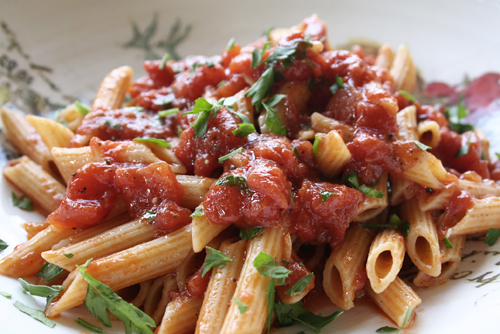
 

Pennette all’arrabbiata: chilli forever!

Who wants to be the first to try the incredible preparation of pennette all’arrabiata? Yes, this delicious and very simple meal is now available for you to taste directly in your lovely and sunny (we hope) kitchen!!!

First of all, it is important to understand the word meaning, to be on the safe side.  The dish is called “arrabbiata” (that is, “angry”) because of the use of chilli. When you approach this “angry” pasta, you can use as much chilli as you want!!!

This recipe comes from the central part of Italy,and now it is spread in every single taverna or restaurant in all the Peninsula! But the roots are in Rome and this dish belongs to the Capital cooking tradition.

Of course, in Italy many versions of pennette all’arrabiata flourished over the centuries: thanks to the different regional cooking traditions, you can also find a very distant food from the original “arrabbiata! Some recipes for example like the use of cream!

The best “arrabbiata”? It should not contain pork meat (usually bacon), widely used in another famous Roma’s dish, the “bucatini all’amatriciana”.

The arrabbiata in its simplest and tasty form includes garlic, lots of chilli, extravirgin oline oil and chopped tomatoes. The secret is to use only fresh top quality ingredients! Adding Parmesan or Pecorino Romano cheese has not to be done!

The ingredients: 500 g of pennette rigate pasta, 90 ml of extra virgin olive oil, 3 cloves of garlic, finely chopped), 3 whole dried red chilli, roughly chopped, and 400 g chopped tomatoes, a small handful of flat leaf parsley and salt for seasoning.

The preparation: chop the garlic and chilli. Heat the olive oil in a pan (medium heat) and put the garlic with the chilli to sauté for 3 minutes.

After the garlic turned gold, put the fresh chopped tomato. Stir for a few seconds, add the salt and stir again for few seconds. Cook on medium/low heat for about 20 minutes, until the sauce reduces.

In the while, the water is boiling for the pasta, and when the pennette are cooked “al dente”, drain it and add it into the pan. Stir for few seconds and sprinkle with chopped parsley.

Mmmmm….. tasty and hot!!!

Focaccia from Liguria (Fügassa) a go-go

Cheese focaccia is a typical recipe from Liguria region in Italy; the real fügassa (this is the local name) comes from the town of Recco.

How to make it in your home-sweet-home? The small bakeries in Recco keep their baking secrets to themselves. However, an homemade cheese focaccia is a lovely thing to bake and it is not that difficult. <of course we advice you a trip to beautiful Liguria to taste a bit of heaven, but in the meanwhile you can cope with your desire and have a go with this delicious recipe!

For the filling, traditional baking of fügassa requires a very fresh “crescenza” cheese, that is a white soft cheese. You can also use buffalo mozzarella or soft “stracchino” cheese.

You can use a bread machine to work the dough and the directions are the following: add 250 ml of tepid water to the bread machine bucket. Add 45 ml of extra virgin olive oil. Then, add 500 g of plain flour to the bread machine bucket and about 1 teaspoon of salt. Remember to knead the dough with the bread machine with its own specific program for “kneading” for about 15 minutes.You can also work the dough by hand for about 10 minutes.


The final result? A dough smooth and elastic! Wrap it into a clingfilm and let it rest for about 40-50 minutes.

After the resting, you can cut the dough in four parts in order to make four balls. Using a rolling pin, make a layer as thin as you can!

Brush your tray (preferably a shallow one, rectangular or circular)with olive oil and cover it with your first layer you have already made.

Add the cheese (280-300 g.) to the top of the first layer. With the second ball of dough prepare another layer and  cover the first layer and the cheese. Open the oven you have pre-heated the oven at 220 ºC (gas mark 7). Put the tray on the top shelf and cook everything for about 20 minutes.

Festival Verdi in Parma: enjoy the great music tradition of Italy

Started the 1st of October and finishing on the 28th Oct 2011, the internationally renowned opera festival “Festival Verdi” is celebrating the composer born in Parma during the month of his birth.

This year Italy is celebrating also the 150th anniversary of its unity, and Verdi’s music evokes for each Italian citizen a strong, intense emotion mingling with a patriotic feeling. Parma and its Festival Verdi becomes the symbol of a nation very proud to celebrate its history and its roots.

The historical town is the incredible scenario in which the festival comes to life: thanks to the Reinassance duchy, the Farnese family, Correggio (1489-1534), the great master of “chiaroscuro”, lived and worked here. In ‘700 the Bourbouns started ruling the town till 1806. In 1816 Parma  Napoleon’s wife, Marie Louise, took the city, but the Bourbons on her death regained the power. In 1860 the territory was finally included in the new kingdom of Italy.

The international “melomani” and opera fans come here every year in the astonishing beauty of Parma, in the region of Emilia-Romagna, to be entchanted by the grace and the power of opera shows!

The beautiful operas chosen to be performed this year are: “Un ballo in maschera”, “Falstaff”, “Aida” as well as the much-loved Requiem Mass. The festival is set in the theatres, opera-houses and other locations in Parma and in Verdi territory, as the composer was born in this extraordinary landscape.

But Festival Verdi is not only music, even though music is of course the main star: meaningful cultural events are surronding the performances and the incredible shows on the stage.

In 2011 the organisation explores the theme of unity and of Italy unification. The programme includes  specific conferences on opera music, and you will find readings from the masterpieces of the Italian and foreign literature which inspired the opera libretti, and many are also the exhibitions related to the main topics.

For booking and any further information, you can call 0521039393, or check www.teatroregioparma.org

Eurochocolate 2011 in Perugia: I LOVE CHOCK

Eurochocolate is today one of the most important events in Perugia. Eurochocolate is the most popular festivals in Italy and followed by everyone who is mad about chocolate. Born in 1994, this festival has started thanks to the effort of Perugina (a well-known Italian brand now owned by Nestlé), a leading manufacturer of chocolate in Italy and worldwide. The events take place in the streets and in the squares of the medieval town: for eight days,  Perugia becomes so frentic and alive,  thanks to the chocolate events, the open air laboratories and tasting sessions of chocolates and wine. Eurochocolate was also known as ” the festival of delicious, unique and diverse”, as the most prestigious Italian and foreign confectionery present their products on this occasion. Brands such as Lindt, Nestle, Caffarel are in this festival.

During the week are many the stands where skilled craftsmen will make giants made of chocolate! So a reign of chocolate confectionery’s sculptures will wait for you!!! The very last days of the festival they are going to be destroyed but no worries! All the pieces are going not in the bin, but in your greedy mouth, cause they will be distributed to all. Confectioners and chefs fight together and create dishes made of chocolate, widely experimenting with new flavours for the starters and main dishes.

During Eurochocolate the old town of Perugia rises the visitors’ presence up to thousands among Italian and foreign tourists, so if you wish to visit the event and the beautiful Perugia, try to go especially on weekdays, in order to avoid problems of crowding!!!

The chocolate is the real star and many visitors just come here to taste loads of gorgeous and yummy specialities.

But Eurochocolate is also culture: it shows also debates and workshops in order to go deeper in the world of chocolate.

Festival and truffle Fairs in Italy

The Fall time is the best period for gourmet to come to Italy. Many activities, medieval festival and truffle fairs are all around, especially in the North of this beautiful country. This is a fab reason to travel to Italy in the fall, properly a foodie’s dream. Mushrooms, chestnuts, truffles and chocolate are waiting for you!
Here is some examples of events worth to try: for instance, a festival recreating the man in the iron mask, Maschera di Ferro, took place in the Piemonte town of Pinerolo the first weekend of October. The man in the mask is played by someone different each year. Sunday afternoon after the story is acted out, the mask is removed to reveal the man wearing it.
Gorgeous are the fall festivals in Umbria, which include: La Festa del Bosco (Woodland fair) from 28 October up to the 1 November in  Montone a beautiful truffle fair such as Mostra Mercato del Tartufo (Trade fair of Truffles) staging 14 /15 October in Pietralunga. Or enjoy the Sagra della Castagna (Chestnut fair) on 21/22 October in Preggio (near Umbertide).
Another Chestnut fair the same date is in Morra (near Citta’ di Castello) while a Trade fair of the truffle and woodland products is on at Monte Santa Maria Tiberina. Inside this festival category you can’t miss the Trade fair of the truffle and woodland products on early November at Citta’ di Castello’s (Citta di Castello).
    And fab is the Gubbio Chocolate Fair ,organised by Altrocioccolato at the end of October!!! alternative and with a focus on sustanability, it is really a nice experience, maybe after going in Perugia to check Eurochocolate, an event we already singled out in this blog. So if you are like my a food-addict, or better a fair-addict, just come around and have a look…not to mention the historical richness and beauty of each small town that hosts the single event!

      The cult of the dead in Naples

      The cult of the dead in Naples is really strong not only during Halloween period: the ghost stories include “munacielli”, “belle ‘Mbriane” and other  paranormal phenomena.

      In Neapolitan esoteric stories,  the bella ‘Mbriana is a must. This romantic Neapolitan legend tells of a princess who had lost her mind: she was caught in a bad romance,  a truly unhappy love affair. So since then she used to wander close to the alleyways of the city like a ghost. Her father the king gave gifts to those houses where the  girl was given help and support. From this it was springing a legend of fortune: in the fervid imagination of Naples people the” bella ‘Mbriana” has become the spirit of the house: she stays forever in a place which she has
      chosen to protect.
      She appears for a few moments, next to a curtain swinged by the wind or in a reflection of a mirror or of a window. Neapolitans imagine her as a
      young woman with a sweet and gentle face, as a clear and bright figure.
      The beautiful entities ‘Mbriane  take revenge on those who offend the house she has put under her support. Old Neapolitans said that you have never to complain about your own house!!

      Did you know that the Basilica of San Pietro ad Aram was built on the site where St. Peter celebrated mass for the first time? Here he baptised also Saint Candida and Saint Aspreno, that is the first Neapolitans he converted to Christianity.

      The Fontanelle cemetry is an old tuff quarry in the Sanità area of Naples, which traces back to the Aragonese period. The name “Fontanelle”, meaning small fountains, comes from the underground springs existing in the area. During XVII century, the quarry was a cemetery: here the people started to bury the victims of the plague, especially the 1656 outbreak.

      Coming to the Italian Fall food festival

      October is perfect for Italian food festivals:  mushrooms, chestnuts, chocolate, and truffles. On October weekends, the stars are the fall food festivals and wine harvest celebrations happening all over Italy. The weather is still warm and it is a perfect month to travel and go visiting town and festivals, especially in the northen and central regions of Italy.

      The Fall Truffle Fairs in Italy can be find in Piedmont, Tuscany, Umbria,  Marche, and Emilia Romagna regions during October and November. Let’s start from the Piedmont region and from one of the biggest truffle festivals in Italy.

      We are talking of the famous Alba White Truffle Festival, an event which takes place  in October in Alba and one of the funniest events is the donkey race.

      A gastronomic fair the first two weekends of October is held in Certaldo Alto, Tuscany, and it is called Boccaccesca.

      A feast of truffles, chestnuts, and chocolate is happening in Umbria: Umbria Fall Food Festivals is a fab occasion to taste this exquisite food! Incredible and ancient is the Feast of the Thrush, la Sagra del Tordo, a medieval festival made of an archery tournament. The Festival is held the last weekend of October  and it takes place in Montalcino in Tuscany. The competition will see fighting the four neighborhoods of the little town.

      Cremona hosts a yummy “Torrone Festival” on the fourth weekend in October: the beautiful town boasts to be the birthplace of torrone, an Italian nougat delikatessen. A document traced back to October 25, 1441, the first coming of  torrone on the table and it was for a royal wedding banquet in Cremona. This is the reason why, during the festival,  the historic wedding is re-enacted for the tourists.

      It is important to notice that Slow Food’s big International Food Event is in October, too, and “World Pasta Day” will arrive the fourth Sunday in October. So a plenty of great recipe and ingredients to try going around Italy!!!


      Strudel “all’Italiana”

      Apple strudel (strudel di mele) is a very popular kind of cake in the North of  Italy. This delicious and rich food comes from Austria and during the domination of  the Austro-Hungarian Empire ruling in the 19th century, the recipe became popular in the regions of Italy (North East) subjected to the Emperor’s power.

      In Trentino Alto Adige, a region of Italy which many of its inhabitants learn and speak German alongside Italian, thanks to its cultural bound with Austria, is the  symbol of this fab cake, at least in Italy. The recipe includes raisins, pine kernels, cinnamon and probably it is coming from  the Middle East culinary tradition. Is it not  interesting that the strudel has some affinities with the Turkish “Baklava”? In Austria the recipe probably arrived between the 16th and 17th centuries, thanks to the huge Turkish invasions that took place in East Europe.

      How to prepare this delicious pastry? You need a ready rolled puff pastry sheet,  100 ml of dark rum, 4 juicy apples, 60 g  raisins, squeezed juice from half a lemon, 60 g of pine kernels, 50 g of sugar, 50 g of apricot preserve, 10 g of butter, 30 g  of breadcrumbs, orange zest from one orange, 2 g  of ground cinnamon, 1 egg yolk, 15 ml of milk.

      You can also make the strudel using filo pastry

      And now the directions: first of all, remember to soak the raisins into the glass of rum, at least 1 hour before you start cooking. Use a sieve and separate the raisins from the rum. Then put the raisins into a small ball or glass and set aside. Do not throw away the rum: 2 or 3 dessert spoons will be added to the strudel filling.

      Peel and slice the apples into small slices and put it into a large bowl, adding some lemon juice. Add the raisins.

      Now add also the pine kernels, the orange zest, the cinnamon, the sugar, the apricot preserve. Mix together and distribute the various ingredients and, to top it all, add 2 or 3 dessert spoons of rum!

      Cover up the bowl with sufficient cling film and set it aside in the fridge until you are ready to use it as filling.

      Put the butter into a pan (over a medium heat) and after a while, add the breadcrumbs. Toast for few minutes until lightly brown. Put the breadcrumbs into a small bowl to cool down and spread some flour onto a working surface. Unroll your pastry and start stretching it with a rolling pin.

      Next, spread the breadcrumbs over the pastry sheet and also your filling. Fold it and roll it gently. Put the egg yolk into a small bowl and add the milk. Beat the egg yolk and milk with a fork until they are mixed. Brush the egg batter all over the strudel. Put all in the oven at 180ºC (gas mark 5).

      Happy Halloween in Italy

      Halloween, or All Saint’s Eve, is becoming a popular day for costume parties and events also in Italy. While the main Italian important and holy holidays are  All Saints Day on November 1 and All Souls Day on November 2, the celebrations for Halloween are spreading in many Italian regions.

      Get prepared! Halloween costumes and decorations can be found in shops and costumes’ stores. Many children’s costume parties are mainly held during the day; in the evening many nightclubs, bars, and restaurants get crazy organising special Halloween costume parties and events.

      Urban Trekking holds in different Italian cities some special All Saints Eve walks. These trips often  offer special visits under the moon and in the deepest dark to medieval castles and towers, creepy crypts and dungeons.In some cities you can find also children’s walks of the same kind during the afternoon.

      Generally, Italy has several displays of mummies and bones in catacombs, churches, and crypts, not just for Halloween, but it is fun doing those kind of visits during this peculiar period.  But look after your children: these mummies have been naturally preserved and the display can be really a chilling and gloomy sight.

      Do not forget that Italian amusement parks held special weekend events in October for Halloween. For instance, if you are near Lake Garda, pay a visit to Gardaland. The famous amusement park offers Magic Halloween, which includes  a ghostly and funny “spirits’ parade”!!! And if you go there dressed up in monster costumes, they will get you a reduced prices: check which is the weekends in October when the offer lasts!

      Movieland has Rock’n Halloween every weekend in October and is open until midnight on Halloween night.

      A few restaurants offer special dinners for Halloween with the pumpkins as a queen among the other ingredients. Delicious as always the Italian food, of course even at Halloween!!!