Spaghetti alla puttanesca: a guilty pleasure

vermicelli-alla-puttanesca-ricetta-classica   Photo CC-BY-SA by Francesco83

The Spaghetti alla Puttanesca has a saucy history, almost as rich as the recipe in front of you. The dish’s scandalous name gives life to many legends.

Many are in fact the theories about the origin of pasta alla puttanesca: according to some, the dish was invented in the early twentieth century in some brothels in Naples as a “refreshment” for guests returning from “the labours of love”, while for others this would be the dish that just women who worked in the brothels ate at dawn to recover from the stressful night.

One of the most popular stories around this delicious spaghetti reports that unfaithful wives cook this dish for their husbands in a great hurry to be soon reunited with their lovers.

A very colourful origins for one of the highlights of Campania’s local tradition!

The origins (without involving any brothel)

The historical background of spaghetti alla puttanesca shows different interpretations.

In “Napoli at table”,  Arthur Schwartz states that etymologically: “(the term puttanesca) was the subject of the efforts of the imagination of many scholars, who have tried in every way to find the solution to the riddle. Some say that the name of this recipe derived, at the beginning of the century, by the owner of a brothel in the Spanish Quarter, which was usually refreshment guests with this dish, taking advantage of the speed and ease of preparation. Others refer to the undergarments of the girls of the house, to attract and entice the eye of the customer, probably wore linen of all kinds of bright colors and full of promising transparency. The many colours of this dress would find themselves in the homonymous sauce: the green of the parsley, red tomatoes, purple dark olive, gray-green capers, peppers garnet hue. Others argue that the origin of the name is to be attributed to the imagination of a young girl’s life Yvette the French, who was inspired to his roots in Provence. Yvette, probably, was not equipped with only fantasy, but also a sense of humour and irony rather caustic, perhaps exploited to celebrate, through the name of this dish, the oldest profession in the world. [… ]”(pg. 164).

A different interpretation is given by Jeanne Carola Francesconi in  “La Cucina Napoletana”: […] These macaroni, although the richest of their relatives, they called marinara. But immediately after the Second World War, in Ischia, the painter Eduardo Colucci, do not know how it cause, they renamed with the name that is now generally known. Colucci, who lived for friends, in summer lived in Punta Mulino – at that time one of the most picturesque corners of Ischia – in a tiny rustic and construction; room with kitchenette and a terrace in the middle of which rose a olive tree. Besides the usual closest friends, paraded on the terrace the most varied Italian and foreign personalities. And he, having offered as an aperitif a fresh and genuine vinello Ischia, often improvised a dinner of macaroni that these were his specialty. […]”.

Another version was instead provided by the architect Sandro Petti, who claimed in an interview that he had invented him the sauce “puttanesca” in his restaurant in Ischia. According to the architect, in fact, this famous recipe was given birth by his culinary genius, when one night arrived hungry at the restaurant a group of his friends. Despite the cook had already left and was not in the kitchen pantry almost nothing left, they insisted to eat something, asking breasts prepare “una puttanata qualsiasi” (indicating that they were content to something simple). So it was that the architect began in the kitchen, took a few simple ingredients and the sauce was invented by the intense flavour and served them to friends over a plate of “pasta al dente”. These appreciated so much the food, that convinced Petti to insert the dish on its menu with the name of “puttanesca” in memory of the request made that evening.

The regional versions

The puttanesca sauce recipe is a very common both in Campania and in Lazio, of which there are several versions: with some chili, other without anchovies, capers and parsley or others with black pepper. Whether its past, the dish holds true as a classic Italian dish.

Spaghetti alla puttanesca
 
Author:
Recipe type: Main
Cuisine: Italian
Ingredients
  • Serves 6:
  • 3 tablespoons butter
  • 3 tablespoons of extra virgin olive oil
  • 6 anchovies pounded to a pulp in a mortar
  • 3 cloves garlic, sliced fine
  • 200 g of black olives, pitted and sliced from Gaeta
  • a spoon salted capers washed and roughly chopped
  • 600 g tomatoes peeled and cut into strips
  • a spoon chopped parsley
  • Salt if necessary
  • 600 g of linguine
Instructions
  1. Put a pan on the stove rather large and be warm with butter and oil, then add the garlic and finely chopped anchovies and previously pounded in a mortar or chopped finely.
  2. When the garlic begins to brown and anchovies melt, add the olives pitted and cut in half, roughly chopped capers and tomatoes peeled and filleted.
  3. Fate then season the sauce over high heat for a few seconds, stirring constantly.
  4. Meanwhile, cook the spaghetti in salted water, drain and place in a bowl in which they serve, then cover them with the previously prepared sauce and sprinkle with parsley.
  5. Mix and serve warm your delicious spaghetti puttanesca!

Piattoni beans and tubettini: a delicious different kind of bean

pasta e piattoni

Beans and pasta
 
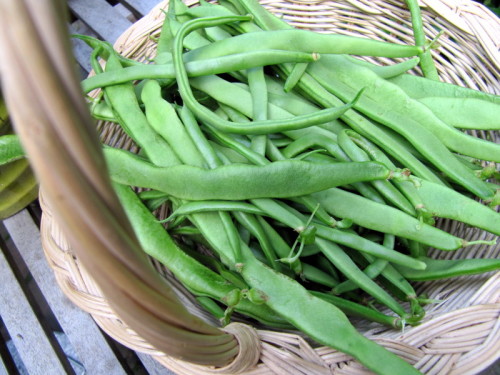
Tubettini with Piattoni beans means a particular type of green beans with a flat shape. You should prepare it with fresh tomatoes or tomatoes puree and a "soffritto" of onions (white for a sweeter flavour or red to gain more consistency). Below an easy and quick but always delicious recipe to prepare tubettini with this kind of beans as a main dish or a first course with lovely Italian pasta.
Author:
Recipe type: Appetiser
Cuisine: Italian
Serves: 4
Ingredients
  • 500 g of Piattoni beans (Flat green beans)
  • 1 Onion (white or red0
  • 100g of Tomatoes puree/a tomato can
  • 4 Tablespoons of extra virgin olive oil
  • Salt
  • Peperoncino (chilly peppers)
  • Pasta: tubettini
Instructions
  1. Wash and clean the beans, cut them in pieces.
  2. Preheat the extra virgin olive oil in a large pan, cut the onion in slices and add them to the pan.
  3. Let the onion sauté for a few minutes. Add all the beans and the tomatoes puree or the tomato from the can or 3 fresh tomatoes.
  4. Sprinkle with salt and cook the sauce for few minutes.
  5. Add 2-3 glasses of water and let the beans cook for about 20 -30 minutes.
  6. Serve very hot with peperoncino (dry hot chilly pepper).


green beans
Green beans

The authentic Minestrone della Nonna (Gran’Ma Minestrone)

italian_vegetable_and_pasta_soup__minestrone_soup

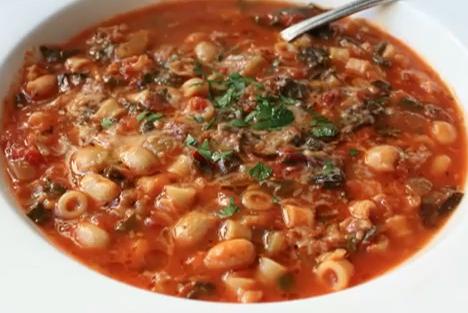
Are you ready to rock this winter in spite of the cold breeze? You need to eat well as your Grannie recommended you one million time. To face with winter, a corroborating dish from the Italian tradition: Minestrone. This particular recipe comes from Abruzzo, even though here the climate is not that bad in winter time as in UK or in some part of USA. But the mountains are full of snow in this region, so the peasants have elaborated this tasty dish for the long, coldish days.

5.0 from 1 reviews
The authentic Minestrone della Nonna (Gran'Ma Minestrone)
 
Author:
Cuisine: Italian; Traditional Italian
Serves: 6
Ingredients
  • 75 g shortcut macaroni
  • 25 g butter
  • 1 tablespoon olive oil
  • 50 g streaky bacon, rinds removed and finely chopped
  • 1 medium onion, finely chopped
  • 3 celery stalks, washed and finely chopped
  • 180 g carrots, washed and finely chopped
  • 2 fresh or tinned tomatoes, chopped
  • 1 clove garlic, crushed
  • 1.5 litres Stock (vegetables- or chicken bone stock)
  • 2 tablespoon fresh chopped parsley
  • 230 g leeks, washed and finely chopped
  • 180 g potatoes, washed
  • salt and freshly milled black pepper
  • lots of grated Parmesan cheese
Instructions
  1. First heat up the butter and oil in a large saucepan, then add the bacon to make the taste superbe.
  2. Cook this for a minute or two before adding the onions, the celery and the carrots. Cover up all with the tomatoes and the crushed garlic.
  3. Adjust with some salt and pepper, cover and cook very gently for 20 minutes to allow all the vegetables to release their inner juice. Occasionally stir to prevent the vegetables sticking.
  4. Then pour in the lovely stock you have chosen along with the parsley.
  5. Bring to the boil and simmer gently for about 1 hour.
  6. Then add the leeks, the potatoes and the macaroni.
  7. Cook for about 20 minutes more.
  8. Just before serving, sprinkle with Parmesan cheese.


Tasty Agnolotti from Piemonte

Agnolotti are a kind of stuffed pasta coming from Piemonte: you can find them filled with cheese, or meat, vegetables. All the recipes‘ variations are delicious and worthy to taste and to prepare.
The shapes are always the same, though, in spite of the variety of  fillings. They have to be square and small,  made from a very thin sheets of pasta.
Which are the ingredients? It seems complicated to make, but it is not, believe me! As a kid, I used to help my granny with her pasta making every Sunday.
Here we go for the pasta: 500 g flour, 8 yolks and 2 whites.
Make the dough from the flour and the eggs , put it in a bowl, cover all with a tea-towel or a wrap, and let it sit.
The filling? 300 g cooked lightly seasoned pot roast, 150 g roast pork loin, 75 g fresh, mild sausage, 100 g brains, 2 tablespoons unsalted butter, a bunch of escarole, Parmigiano, 3 eggs, freshly grated nutmeg, salt.

Boil the sausage and the brains for a few minutes, then remove them and let them cool. Remove the sausage skin and crumble it, while removing the pig brain’s membranes. Mince it all with the cooked escarole. Mix all the ingredients in a bowl with your fingers.

Take the pasta dough, cut and shape the sheet into two equal-sized pieces, and make the squared shapes for agnolotti. put the filling in one square and cover with the other pasta’s little square.

The sauce to dress our fab dish? The most common are butter and fresh sage, freshly grated Parmigiano or Grana Padano  Boil the agnolotti in a meat stoke, take them out and season them with the butter and sage along a light red.

Bottarga and pasta: a perfect marriage

This recipe, my lovely friends,  is super  for seafood lovers and aficionados!

Bottarga and pasta merge in a great dish! But what is Bottarga?

One of the great delicatessen coming from Sardinia and Sicily, meaning tuna or mullet roe, in origin used to make the bottarga sauce to top  pasta.

You can find the precious ingredient in any Italian deli shop in Britain.  The pasta? You can use  “linguine” or “spaghetti” and in general it is better a kind of “pasta lunga” like the one aforementioned.

The ingredients are 400 g (14 oz) linguine or spaghetti, 70 ml (2 fl oz) extra virgin olive oil, 1 garlic clove, 120 g (4 oz) tuna roe,  and parsley.

How can you make it? Very, very easily.

The sauce rules! Grate the cod roe, put the olive oil into the pan and heat it with some garlic. Sweat the garlic off until it turns golden, then remove it from the pan.

Then, boil the linguine pasta and while it is boiling, you can proceed with the sauce preparation.

Next, move the pan away from the heat and leave the oil to cool down for a minute or so. Then, add 2/3 of the grated cod roe into the pan and give it a good stir.

Add a bit of the parsley into the pan and season with black pepper. Finally, add a couple of spoonfuls of the boiling water you are using to boil your pasta. Stir to make a creamy mix. When your sauce is ready, and when the pasta is cooked “al dente”, just before draining it, put the pan containing the sauce over the heat again. Drain the pasta,  leaving it slightly wet.

Add the pasta into the sauce pan and sprinkle with the remaining grated cod roe and the remaining parsley and stir well for a minute.

You will serve the pasta “alla bottarga” with a nice glass of white wine. Don’t add Parmesan cheese!