Panettone recipe: how to make a taste of Heaven

Never made a panettone? Work the dough, if possible, with a dough mixer also because beating times with a mixer are about 20 minutes, where hand-beating will require about 50.
The room? It must be warm, about 72 degrees F (22 C).

The flour? It should be about 68 F (20 C) and a very fine all-purpose flour, extremely dry.

The water? Again it should be warm, about 76 F (24 C).
Add also a pinch of salt, because this trick stimulates the rising.
Bakeries use a sour dough starter (like the wild yeast). Home recipes generally uses baker’s yeast, too.

The baking time? It will depend on the size of our panettone. An oven temperature of 400 F (200 C) will be fine for  half an hour of baking. This is ok for a small to medium-sized panettone: larger ones will require more time. Better to try a small-medium sized one, then, at home.
A little trick: slip a bowl of water into the oven when the panettone is half-baked to raise the humidity so the surface of the cake will be shining!
For a tall panettone, put a ring of heavily buttered thick paper around the dough then put it in the oven.  We have also a double rising to wait for!

For the first rising you will need5 ounces (140 g) fresh yeast cake, 3 1/3 cups (400 g) flour, 3/8 cup (90 g) unsalted butter, 5/8 cup (110 g) sugar, 6 yolks, 1/2 teaspoon salt, 4/5 cup (200 ml) tepid water
For the second rising, you will add 2 1/3 cups (280 g) flour, 5/8 cup (110 g) unsalted butter, 7/8 pound (400 g) sultana raisins,  1/2 cup (100 g) sugar, 1 1/2 teaspoons vanilla extract, 1 teaspoon honey, 1/2 teaspoon salt and 6 yolks.

You have to start the afternoon before you actually bake the panettone. Cut the butter and melt it over a very low flame or a double boiler. Put the sugar in about 2/5 cup of warm water. Put the melted butter, salt, and yeast cake in a mixing bowl  and mix well.

Add the yolks and sugar and put in the flour. Mix for 25 minutes and put the dough in a lightly floured bowl. Cover it with a heavy cloth, and keep it warm.

After the raising, take the dough and work with the flour, vanilla, yolks and honey. Mix for about a half hour, put 2 tablespoons of the butter, melted as before, and a little water. Add the fruit, mix and round the balls of dough.

Let them rise in a warm place for a half hour. Put the panettone in panettone molds and put them in a warm spot to rise for 6 hours.

Put the panettone in the oven and Merry Christmas!


Frico: a gorgeous recipe from Udine

Frico is a fantastic recipe made from cheese and potatoes. In the North West corner of Italy, Frico is a typical dish originated from the Friuli Venezia Giulia region of Italy.  In some parts of the region people like to add onions, some others like to put an egg  into the mix. In the end adjusts the frico recipe, often to follow their family tradition.

The two fundamental ingredients for the frico recipe? Potatoes and cheese.The egg is required to increase the volume of the dish!  Sometimes instead of boiling the potatoes, some people just grate the uncooked potatoes and carry on making the frico, like the Swiss potato rösti.  For the frico recipe the cheese is really important; just use the type of cheese they made in Friuli region: Montasio cheese.

So Boil the potatoes, smashed with a fork and add half of the amount of  fresh Montasio (about 2 months old) and half of a semi-aged Montasio (about 5 months old), otherwise use what you can get. A fresh cow’s milk cheese will be also good. You may find this type of cheese in an Italian deli shop or from a continental cheese importer.

Try not to go cheap on the cheese! And please, if it is impossible for you to get a lovely Montasio, whatever age you can find it, then look for Asiago cheese. It is really good indeed and  it will work as good as the Montasio’s one!

If you are not kissed by the luck’s fairy, no panic at all! Just look for some good mild cow’s milk cheese. You can eat with rye bread (or German type bread) and a glass of red wine (Montepulciano).


Home made bread: yummy recipe

Make bread at home this winter! the “Pane fatto in casa”‘s recipe will explain how to make your own Italian country bread at home! In Italy there are lots of varieties of bread: the art of making this delicious food also gives a lot of different names to the results.

It depends on the region of Italy the recipe comes from. let`s try to make Altamura type of bread. it comes from Puglia, a region located in the South of Italy

Ingredients are: 500 g (1.1 lb) Durum wheat semolina, 10 g (a bit less than ½ oz) Fresh yeast, 10 g (1 tbs) Salt, 300 ml (½ pint) Warm water (1 part hot and 2 parts cold), 7.5 ml (½ tbs), ½ tsp of sugar

Ready for the directions?

Put 150 ml of warm water into a jug. Break the fresh yeast (you can buy from Jewish shops a really good one) into pieces and put it into a jug as well. Add the sugar and stir until the yeast is completely dissolved. Cover the jug with a towel and leave to rest (ca. 10 minutes). Put the semolina flour into the big bowl, add the salt and stir. After 10 minutes, whisk  a bit. Work the dough and Put the remaining 150 ml of warm water into the jug. Add the semolina flour into the bucket. On the top of the flour add the remaining 150 ml of warm water.

Knead the dough and when it is ready, sprinkle some plain flour in the bottom of the bowl. Put  the dough into the bowl and cover. Rise the dough inside the oven (you preheat it and leave it on off mode, then put the dough) to rise for 2 hours.

Now put the dough on a working surface, work it with your hands and make a rectangular layer (20×30 cm and 2-3 cm thick). Put on the tray, sprinkle some flour or olive oil and it is done!


Seafood pizza: when the Earth meets the water

The  seafood pizza: when Earth meets water! A fab opportunity to put together ingredients coming from different “worlds”: the flour coming from mother Earth and from its tasty fruits, and the fish, coming from the sea and the ocean , so healthy for the persons and so tasty for you! It is difficult to resit to the enchanting call of this syren! So come on board to read one of the good and different golden crispy pizza full of love and fish!

If you have already made the pizza dough, for the topping you need to use 1 Monkfish tail, Tiger prawns
Green olives (stoned), Caper berries, Tomato passata di pomodoro. You can add also some fresh basil leaves and coarse semolina flour  for the pizza peel.

When making pizza,always avoid topping the pizza with fresh tomatoes! The  waterly juice content inside them will make the pizza base soggy. Dry the tomato first and put it on in the oven. Set the oven at its lowest (around 100C) and in a couple of hours it is going to be done. The tomatoes should  retain a slight juiciness. Pre-heat the oven, cut the monkfish tail into pretty small pieces, put some coarse semolina flour onto the pizza peel.

Move the pizza base on the peel, quickly sprinkle the tomato sauce and top the pizza base with the ingredients you have chosen.

A final splash with olive oil all over the pizza will help to cook a bit everything in a soft way.

Nowall in the oven and bake it for 5-7 minutes until the base looks crispy and golden!!!

Pizza recipes: tricks and treat

How to make a good home made pizza? The recipe is still fundamental for those who are trying to make pizza for the first time  and want to achieve a crispy result. At home, it is not that easy to duplicate the same pizza you have tasted in Italy, coming from the hands of a “pizzaiolo” and from the womb of a wood burning oven!!

The  flour is chosen with care and the pizza master can make the dough fly in the air. But also we simple home cooks have our little tricks to make real and good out attempt to make an home-made  pizza.

Let’s talk about the flour: in Italy, most of the pizza professionals use “00” flour, a very fine type but  there are many different “00” kind in the Italian market, to suit specific uses. As a general guidance to make pizza,you should use an Italian “00” type flour made from soft wheat.In those countries where the flour is classified as soft, plain, strong and very strong, it is better to use plain flour. Strong and very strong flours are for making the traditional bread.

For the dough, you should use flour, water, yeast and a bit of olive oil. The ideal temperature for the pizza dough? 22°C.

You can raise the dough for two hours but it is even better if you can wait at least 8 hours: in this way  the dough can have the time to develop flavour and texture.

A traditional pizza base has to be very thin: so put  a thin pizza base, in a very hot oven! Use “passata di pomodoro”, a bit of oregano and olive oil, if you want.

If you have a professional electric oven, the oven temperature should be between 280°C and 320°C  while the cooking time should be 3-4 minutes. With a home cooker oven, don not go above 240°C (gas mark 9), while you need to cook the pizza for about 7-10 minutes.


Napoli Pizza: the story and the fun

Campania is renowned around the world for its exuberant food which is full of sun: vegetables and herbs, salty capers, dried pasta, and fresh farmhouse cheeses like the great  buffalo’s Mozzarella (Mozzarella di bufala). An outstanding gourmet’s favourites mozzarella cheese,  the Mozzarella di Bufala coming from this region is totally famous and a fab choice to add to your great dishes.

The fertile soil around the Vesuvius and a wealthy fishing industry make Campania  one of the most flavoursome and interesting cuisine in the whole Italian Peninsula.

The seafood dishes are tasty while the pastries comes from the Far East: Greek and Arabic influence and heritage show off in some dishes that often contain honey, nuts, and a lot of different spices. Another great Campanian dish is melanzane alla parmigiana: a multitude of fried slices of aubergine gratineed with tomato sauce, mozzarella and parmesan cheese!!!


During the nineteenth century, all the people in the city of Naples were nicknamed as “Mangia Spaghetti” (Spaghetti Eaters). Naples in particular is  famous for its pasta dishes: here spaghetti is served along with sugo di pomodoro, a tomato sauce. Neapolitans still remain attached to this tradition of pasta-addicts, also because their pasta is  home-made and it is the most various  and best quality pasta in Italy.

But Naples is the undeniable home of the most famous Italian dishes: the ‘pizza’ . Everyone knows that and during a trip in Naples, you can’t avoid eating it!!!

The Pizza Margherita is particulary famous: this variety of pizza was created and named after Queen Margherita, when the royal family visited the city. This delicious and tasty dish is made with a lot of mozzarella cheese,  tomatoes and basil: each ingredients represents indeed the red, white, and green of the Italian flag.


Pennette all’arrabbiata: chilli forever!

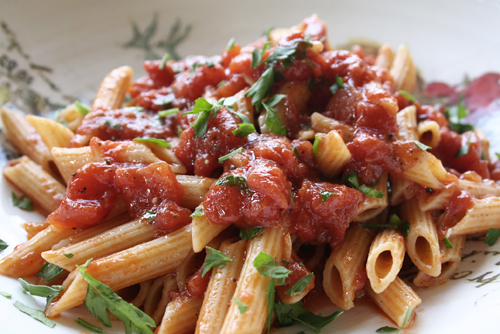
Who wants to be the first to try the incredible preparation of pennette all’arrabiata? Yes, this delicious and very simple meal is now available for you to taste directly in your lovely and sunny (we hope) kitchen!!!

First of all, it is important to understand the word meaning, to be on the safe side.  The dish is called “arrabbiata” (that is, “angry”) because of the use of chilli. When you approach this “angry” pasta, you can use as much chilli as you want!!!

This recipe comes from the central part of Italy,and now it is spread in every single taverna or restaurant in all the Peninsula! But the roots are in Rome and this dish belongs to the Capital cooking tradition.

Of course, in Italy many versions of pennette all’arrabiata flourished over the centuries: thanks to the different regional cooking traditions, you can also find a very distant food from the original “arrabbiata! Some recipes for example like the use of cream!

The best “arrabbiata”? It should not contain pork meat (usually bacon), widely used in another famous Roma’s dish, the “bucatini all’amatriciana”.

The arrabbiata in its simplest and tasty form includes garlic, lots of chilli, extravirgin oline oil and chopped tomatoes. The secret is to use only fresh top quality ingredients! Adding Parmesan or Pecorino Romano cheese has not to be done!

The ingredients: 500 g of pennette rigate pasta, 90 ml of extra virgin olive oil, 3 cloves of garlic, finely chopped), 3 whole dried red chilli, roughly chopped, and 400 g chopped tomatoes, a small handful of flat leaf parsley and salt for seasoning.

The preparation: chop the garlic and chilli. Heat the olive oil in a pan (medium heat) and put the garlic with the chilli to sauté for 3 minutes.

After the garlic turned gold, put the fresh chopped tomato. Stir for a few seconds, add the salt and stir again for few seconds. Cook on medium/low heat for about 20 minutes, until the sauce reduces.

In the while, the water is boiling for the pasta, and when the pennette are cooked “al dente”, drain it and add it into the pan. Stir for few seconds and sprinkle with chopped parsley.

Mmmmm….. tasty and hot!!!

Focaccia from Liguria (Fügassa) a go-go

Cheese focaccia is a typical recipe from Liguria region in Italy; the real fügassa (this is the local name) comes from the town of Recco.

How to make it in your home-sweet-home? The small bakeries in Recco keep their baking secrets to themselves. However, an homemade cheese focaccia is a lovely thing to bake and it is not that difficult. <of course we advice you a trip to beautiful Liguria to taste a bit of heaven, but in the meanwhile you can cope with your desire and have a go with this delicious recipe!

For the filling, traditional baking of fügassa requires a very fresh “crescenza” cheese, that is a white soft cheese. You can also use buffalo mozzarella or soft “stracchino” cheese.

You can use a bread machine to work the dough and the directions are the following: add 250 ml of tepid water to the bread machine bucket. Add 45 ml of extra virgin olive oil. Then, add 500 g of plain flour to the bread machine bucket and about 1 teaspoon of salt. Remember to knead the dough with the bread machine with its own specific program for “kneading” for about 15 minutes.You can also work the dough by hand for about 10 minutes.


The final result? A dough smooth and elastic! Wrap it into a clingfilm and let it rest for about 40-50 minutes.

After the resting, you can cut the dough in four parts in order to make four balls. Using a rolling pin, make a layer as thin as you can!

Brush your tray (preferably a shallow one, rectangular or circular)with olive oil and cover it with your first layer you have already made.

Add the cheese (280-300 g.) to the top of the first layer. With the second ball of dough prepare another layer and  cover the first layer and the cheese. Open the oven you have pre-heated the oven at 220 ºC (gas mark 7). Put the tray on the top shelf and cook everything for about 20 minutes.

Strudel “all’Italiana”

Apple strudel (strudel di mele) is a very popular kind of cake in the North of  Italy. This delicious and rich food comes from Austria and during the domination of  the Austro-Hungarian Empire ruling in the 19th century, the recipe became popular in the regions of Italy (North East) subjected to the Emperor’s power.

In Trentino Alto Adige, a region of Italy which many of its inhabitants learn and speak German alongside Italian, thanks to its cultural bound with Austria, is the  symbol of this fab cake, at least in Italy. The recipe includes raisins, pine kernels, cinnamon and probably it is coming from  the Middle East culinary tradition. Is it not  interesting that the strudel has some affinities with the Turkish “Baklava”? In Austria the recipe probably arrived between the 16th and 17th centuries, thanks to the huge Turkish invasions that took place in East Europe.

How to prepare this delicious pastry? You need a ready rolled puff pastry sheet,  100 ml of dark rum, 4 juicy apples, 60 g  raisins, squeezed juice from half a lemon, 60 g of pine kernels, 50 g of sugar, 50 g of apricot preserve, 10 g of butter, 30 g  of breadcrumbs, orange zest from one orange, 2 g  of ground cinnamon, 1 egg yolk, 15 ml of milk.

You can also make the strudel using filo pastry

And now the directions: first of all, remember to soak the raisins into the glass of rum, at least 1 hour before you start cooking. Use a sieve and separate the raisins from the rum. Then put the raisins into a small ball or glass and set aside. Do not throw away the rum: 2 or 3 dessert spoons will be added to the strudel filling.

Peel and slice the apples into small slices and put it into a large bowl, adding some lemon juice. Add the raisins.

Now add also the pine kernels, the orange zest, the cinnamon, the sugar, the apricot preserve. Mix together and distribute the various ingredients and, to top it all, add 2 or 3 dessert spoons of rum!

Cover up the bowl with sufficient cling film and set it aside in the fridge until you are ready to use it as filling.

Put the butter into a pan (over a medium heat) and after a while, add the breadcrumbs. Toast for few minutes until lightly brown. Put the breadcrumbs into a small bowl to cool down and spread some flour onto a working surface. Unroll your pastry and start stretching it with a rolling pin.

Next, spread the breadcrumbs over the pastry sheet and also your filling. Fold it and roll it gently. Put the egg yolk into a small bowl and add the milk. Beat the egg yolk and milk with a fork until they are mixed. Brush the egg batter all over the strudel. Put all in the oven at 180ºC (gas mark 5).

The piadina from Romagna: the yummy mother of every flatbread

The “Piadina flatbread” is probably the most famous food symbol in Romagna, an area located at the east of the city of Bologna. Romagna is famous for  the provinces of Forlì-Cesena, Rimini and Ravenna and for its traditional food: fish from the sea, meat from the hills, wine and oil, strutto and tortellini.

Coming back to the Piadina, you can’t mistake it with other types of good flat bread as pitta bread, fajitas, naan bread. You can eat the piadina with a selection of Italian cured meats (coppa, salame, mortadella, prosciutto crudo, pancetta, bresaola) or with different types of cheese as squaccherone, robiola, asiago, and so on.

Now the recipe for one of the yummiest flatbread ever!! For 4 or 6 persons, you will need: 1 kg (2.2 lb) of white flour (Italian “00” flour or equivalent), a heaped teaspoon of salt for seasoning, 100g (4 oz) pork lard and 15 g (½ oz) of baking powder.

First, you should put the flour on a flat board and make a well in the centre. After you should put the salt into the well and spread the baking powder onto the flour. Important will be to put all the lard (in Italy it is the “strutto”) into the well. If you have the lard in the freezer, take it out the night before!

Ok, back to our recipe: take some hot water and pour a very small quantity of it onto the lard: with one hand work this in order to melt it completely.

After all the lard is melted, start working the dough. Remember not to use water unless you feel it is absolutely necessary to work in all the flour.

The dough externally should be smooth, not too soft, not too hard. Then, wrap the dough in a old and clean cloth or in a tea towel, and soon after just put it in a plastic bag  to rest for half an hour.

It should look smooth and white when you take it to work again. Break in smaller balls  and start to flatten this amount of dough with a rolling-pin.

Work the dough trying to turn the medallion clockwise when rolling, to ensure that all the sides are at the same thickness.

The piadina is ready to be cooked!!!!!!!!!!!! Make sure that the surface is flat and smooth and use a flat pan. You should put the pan on the cooker when it is very hot, you will put the piadina. At this stage it may rise a bit or a few bubbles. Fork the bubble, so the surface will be flat.

When the bottom surface turns into a kind of not uniform light brown colour , turn the piadina on the other side and voilà! The results is a  Italian delicious dish!!!!